The P2P network
that's already in your wallet.
A new person-to-person payment solution built in partnership with Mastercard and Visa. No asking about apps. No downloading something new. Just send the money.

I met Carl while traveling for an event this week. Over the next couple of days, we coordinated over text and got to talking. By the end of the trip, we’d moved past logistics and onto family and golf.
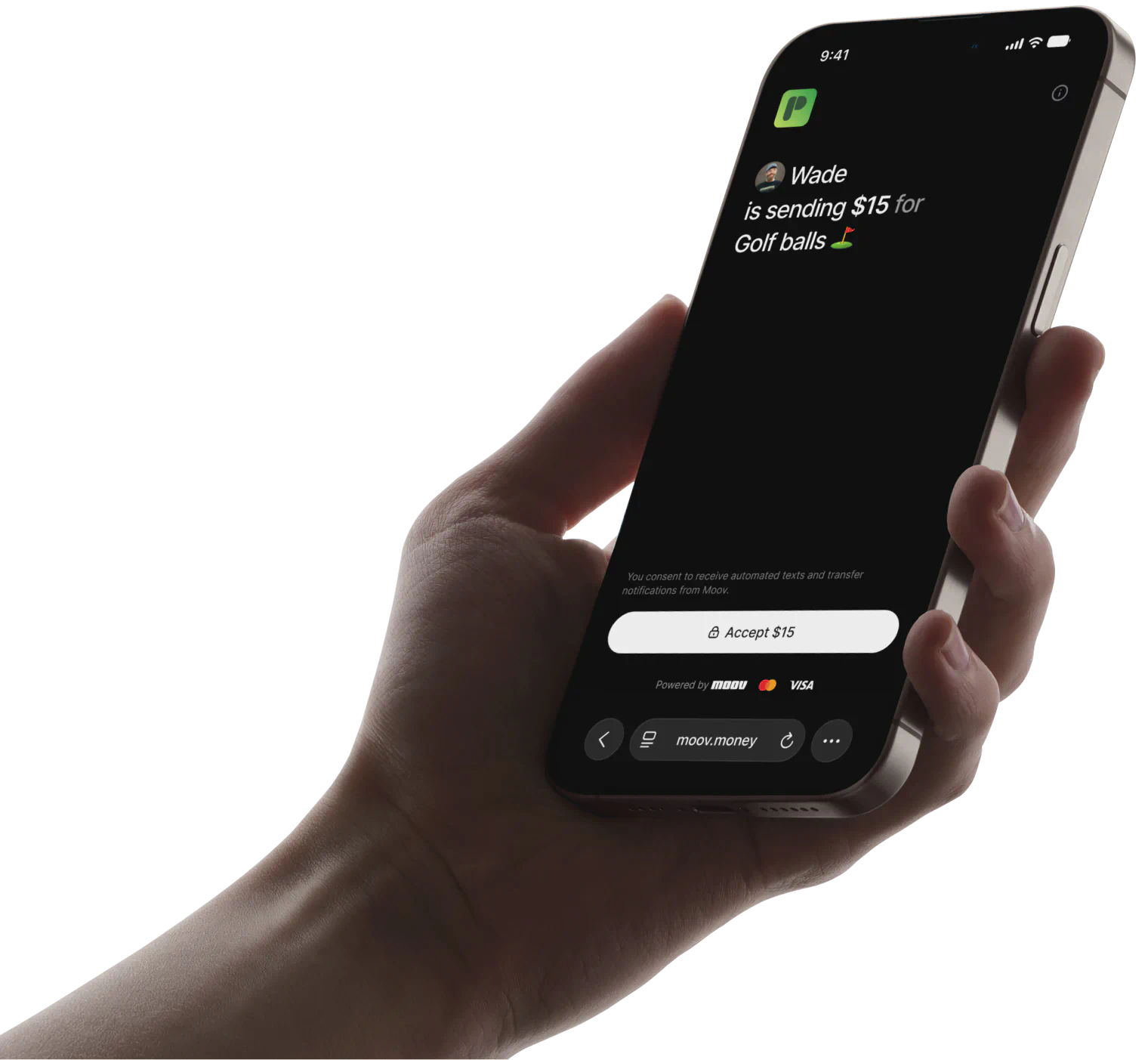
Before I headed home, I wanted to do something nice for him. We’d been talking about golf, so I opened up Moov Money and surprised him with $15 for a sleeve of golf balls, right in the same text thread we already had going.
The payment showed up in our texts. Carl accepted it, and the money transferred instantly.
I never asked Carl which payment app he uses. I didn’t ask for a handle or search for him on another network. He didn’t download a new app. We had known each other for all of 48 hours. We didn’t share a payment app.
We shared a conversation.
And that conversation already had something most payment experiences have to work pretty hard to establish: trust. The payment came from my number in the same thread we’d been using for two days. Carl knew exactly who it came from and why.
His response was just as personal. He thanked me, told me he’d put the golf balls to good use, and wished me a good trip home to my family.
It was a small exchange, but it captured a lot of what we’ve been trying to build.
Today we’re launching Moov Money, a new person-to-person payment network built in partnership with Visa and Mastercard.
The idea behind it is simple: if you have a debit card, you should be able to send and receive money with anyone else who has a debit card.
No asking about apps. No downloading something new. No moving money into another wallet just so you can move it into your bank account later.
Just send the money.
That sounds obvious. But it isn’t how P2P payments work today.
P2P has a network problem
Most P2P products split the world into two groups: people who have the app and people who don’t.
If we both use the same service, sending money is easy. If we don’t, one of us has to sign up for something new or find another way to move the money.
That model has created some very large P2P networks, but even the most widely adopted service reaches just 34.6% of U.S. consumers.
Meanwhile, 90.5% of U.S. consumers already have a debit card.
P2P market share
| Payment method | Share of US consumers | |
|---|---|---|
| Debit card | 90.5% | |
| PayPal | 34.6% | |
| Venmo | 33.9% | |
| Zelle | 30.3% | |
| Cash App | 21.0% | |
Share of US consumers. Debit card: 2025 Survey and Diary of Consumer Payment Choice. Payment apps: 2024 Survey and Diary of Consumer Payment Choice. Federal Reserve Banks of Atlanta and San Francisco.
So instead of building another closed network and trying to convince millions of people to join it, we asked a different question:
Why not use the network already sitting in their wallets?
That’s Moov Money.
The debit card becomes the destination
Moov Money runs on Visa Direct and Mastercard Move, allowing money to move directly to the account behind an eligible debit card.
The person receiving money doesn’t need to use Moov Money. Their financial institution doesn’t need to offer Moov Money. They don’t need to download an app or cash out of a wallet afterward.
They need a debit card.
Behind the scenes, Moov connects a phone number, contact, or Moov Tag to the payment destination and handles the infrastructure required to make the experience work across financial institutions.
For the people using it, most of that complexity disappears.
You choose who you want to pay. You send the money. They choose where they want to be paid.
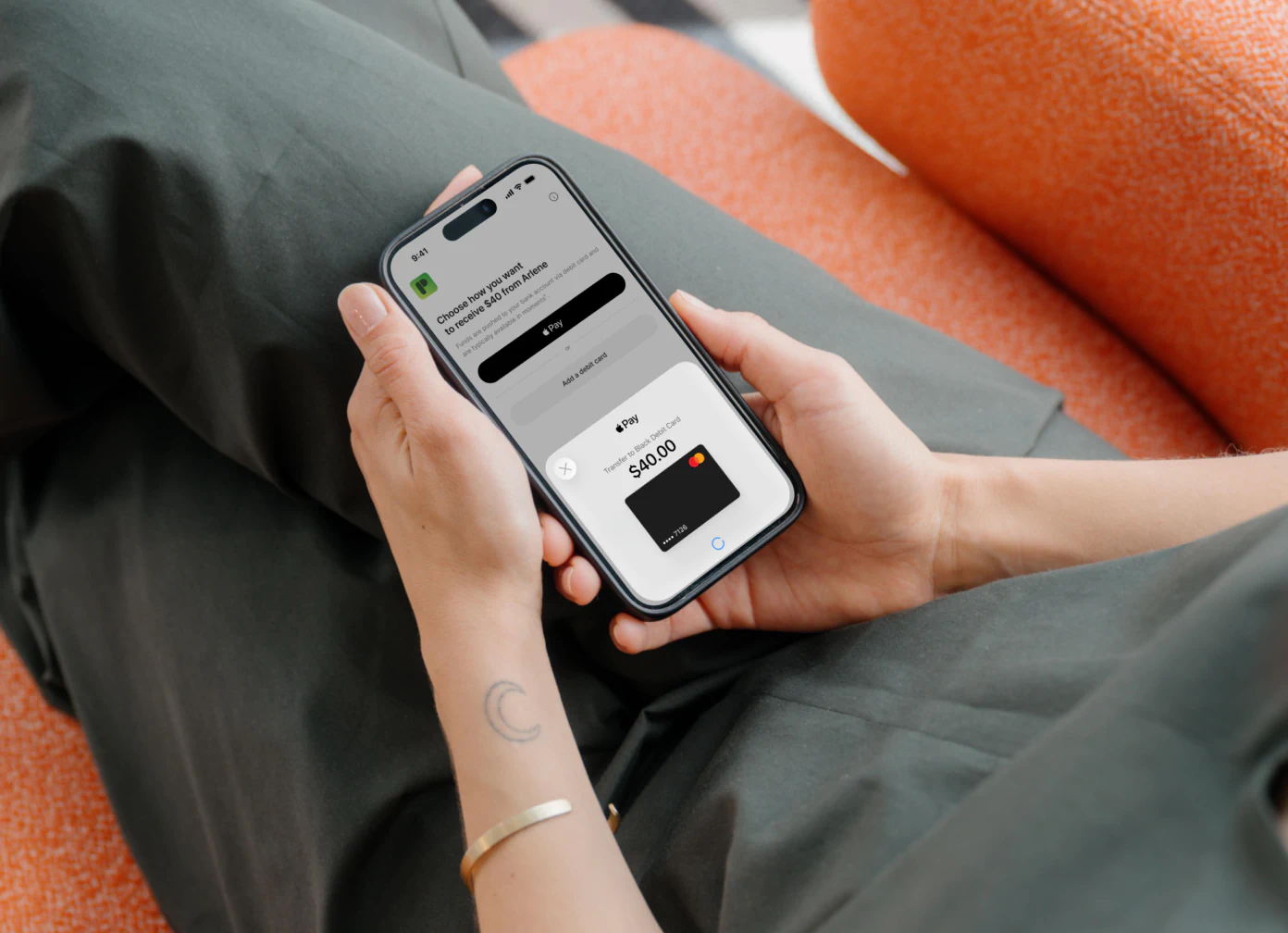
That solves the reach problem. But there’s another part of P2P that matters just as much: trust.
The text thread is the trust layer
What matters is where the payment shows up.
It shows up in the same conversation you’ve been using to make plans, share updates, or just talk. It comes from a number you recognize, alongside messages you’ve already exchanged.
We don’t have to manufacture trust. The trust is already there. We just had to not break it.
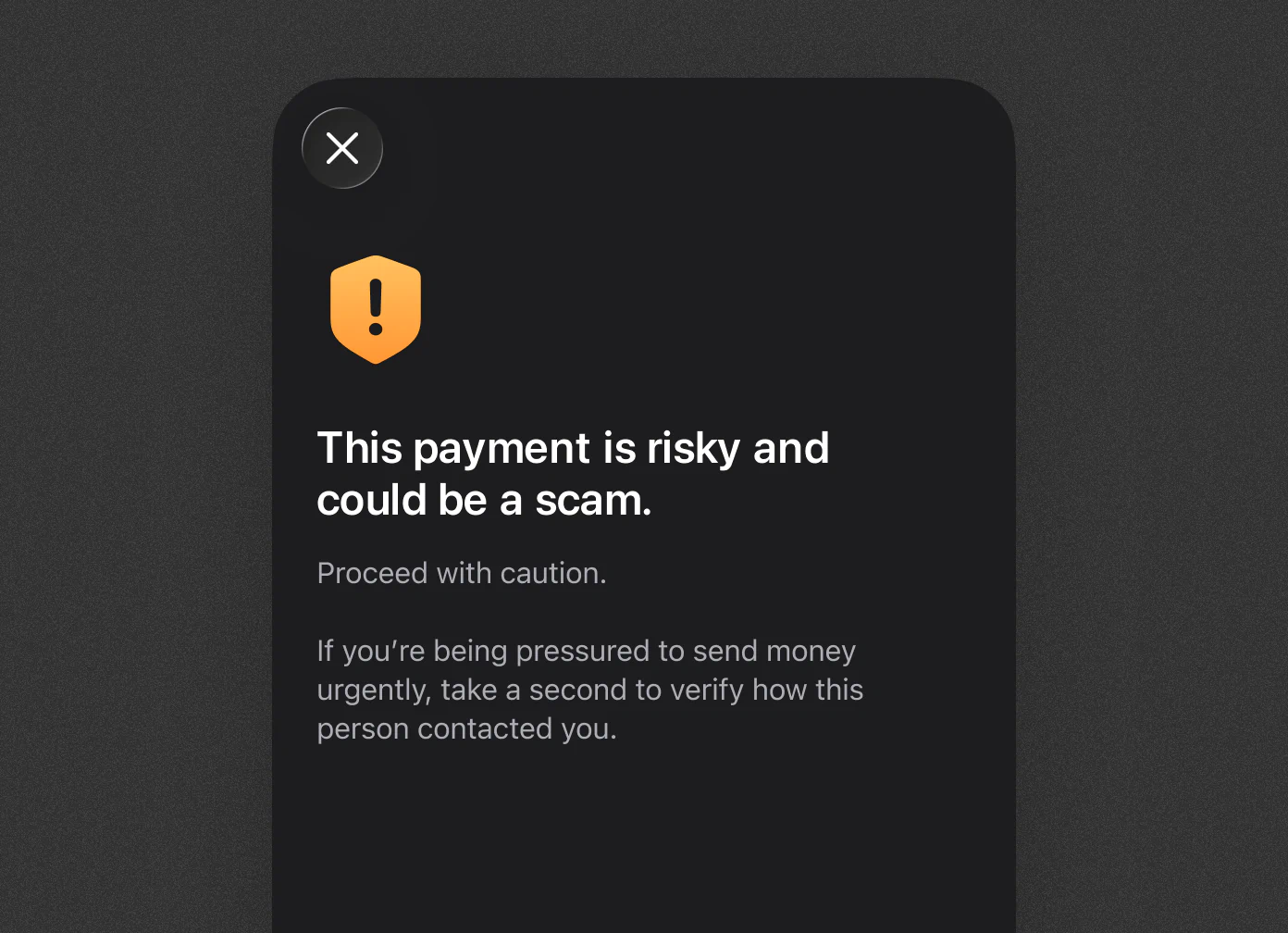
That matters because a generic “you’ve got money” message from an unfamiliar brand or short code can look a lot like a scam. A payment shared by someone you know, inside a conversation you’re already having, is different.
The sender is the trust. We’re just the rails.
P2P belongs with financial institutions
There’s another piece of this that matters to me.
Banks, credit unions, brokerages, and neobanks have built relationships with the people who trust them with their money. Yet when those account holders want to send money to someone, they’re often prompted to use a third-party app.
The account holder leaves the bank’s experience, and the money often leaves with them.
Every dollar moved from a checking account into a third-party wallet is a dollar that is no longer sitting with the financial institution where the customer actually banks. At scale, that matters.
I don’t think financial institutions should have to give up that relationship to offer a modern P2P experience.
Moov Money is built for banks, credit unions, brokerages, and neobanks, and lives inside their experience and under their brand. The institution owns the experience. And when someone receives money, those funds can land directly in the account behind their debit card rather than sitting in a separate wallet waiting to be transferred out.
Moov operates the network. The financial institution keeps the relationship.
Built to be something financial institutions can actually ship
We also didn’t want to build a network that takes a year-long technology project to join.
Moov Money is available through an SDK and UI library and through participating digital banking providers, with deployment possible in about a week.
Out of the box, financial institutions can offer:
Reach across eligible debit cards
Send to eligible Visa and Mastercard debit cards, including recipients whose financial institution hasn't integrated Moov Money.
One-tap acceptance
Apple Pay and Google Pay let eligible recipients accept without manually entering a card number.
Stay top of wallet beyond P2P
Cards enrolled in Visa and Mastercard credential directories can be recognized across ecommerce and other online payment experiences.
Direct-to-account deposits
Money stays with financial institutions instead of sitting in a separate P2P wallet.
Security that stays out of the way
Passkeys, identity and card verification, device intelligence, network-level risk controls, social proof, active-call detection, and trust prompts working throughout the experience.
Integrated end-user support
Reduces the burden on financial institution service teams.
There’s a lot happening behind a P2P transaction. The people sending and receiving money shouldn’t have to think about most of it.
The network was already there
We’ve spent a lot of time building the infrastructure behind Moov Money. The best part is how little of it you have to think about when you use it.
You know who you want to pay. So you pay them.
Moov Money is available today for banks, credit unions, neobanks, and brokerages in the U.S.
Moov Money is a service of Moov Financial, Inc. and is offered through participating financial institutions, brokerages, and fintech providers. Moov Financial, Inc. is not a bank. Your funds are held by your participating financial institution, and payments are made from the eligible account you select. Availability, features, and limits vary by institution and are subject to its terms and conditions. Moov Money is currently available only in the United States.
Payment speed. Most payments are available to recipients within minutes of being claimed. Actual timing depends on the recipient’s financial institution and the payout method they choose; some payments may take up to 3 business days.
Fraud monitoring. Real-time monitoring helps identify scams and suspicious activity, but no security system can prevent all fraud. Only send money to people you know and trust. Moov will never ask you for your password, PIN, or a one-time verification code.
Recipient eligibility. Recipients do not need an account at a participating institution to claim a payment, but must provide an eligible U.S. deposit account, debit card, or wallet to receive funds. SMS message and data rates may apply.
Institution participation. To send or request money, your financial institution must participate in Moov Money. Anyone with an eligible U.S. debit card can receive money or pay a request, even if their financial institution does not participate.
Moov® and the Moov logo are registered trademarks of Moov Financial, Inc. Moov Money is a trademark of Moov Financial, Inc. Visa is a registered trademark of Visa International Service Association. Mastercard and the circles design are registered trademarks of Mastercard International Incorporated. Apple, the Apple logo, and iPhone are trademarks of Apple Inc., registered in the U.S. and other countries. Google Pay and the Google Pay logo are trademarks of Google LLC. All other trademarks, logos, and brand names are the property of their respective owners.